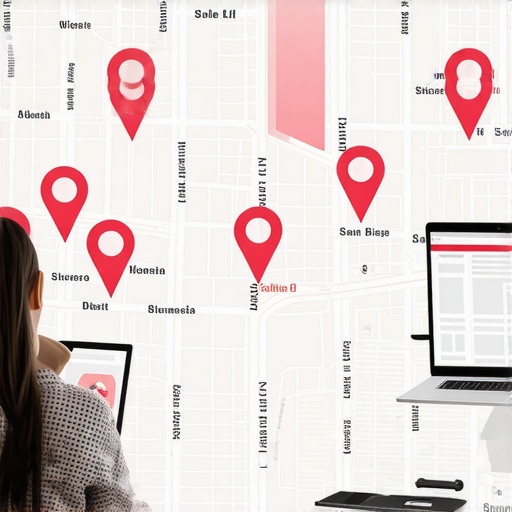
Why Most San Diego Businesses Get Local Keyword Tracking Wrong
In the high-stakes digital landscape of San Diego, from the bustling corridors of the Gaslamp Quarter to the affluent coastal enclaves of La Jolla, the battle for local visibility is fiercer than ever. My name is Christian Hidalgo, and I have spent years managing local search engine optimization campaigns for over 100 national customers. If there is one thing I have learned, it is that most business owners are operating under a dangerous delusion. I call it the “Rank 1 Myth.”
You know the feeling: you sit down at your desk in your Clairemont office, type your primary service into Google, and see your business sitting proudly at the top of the Map Pack. You assume you’re winning. But here is the cold, hard truth – the customer sitting in a coffee shop in North Park or a resident searching from their home in Chula Vista is likely seeing a completely different reality. Because you are tracking your rankings from a fixed point (your office), your data is fundamentally flawed. In San Diego’s fragmented geography, proximity is king, and if you aren’t tracking your visibility across a multi-point grid, you aren’t just getting the data wrong – you’re losing money to competitors who understand the game better than you do.
The Death of the “Average Rank” in Local SEO
For decades, traditional SEO tools have conditioned us to look at “Average Rank.” These tools typically ping a Google data center from a single IP address or a generalized zip code and return a number. While this works for national organic search, it is utterly useless for local map pack seo. In the world of the Google Business Profile (GBP), there is no such thing as a static rank. Your position is a fluid, living entity that changes every few blocks.
The urgency of getting this right cannot be overstated. Google data shows that 76% of people who search for local businesses on their phones visit one within a day. If you aren’t appearing in the “3-Pack” at the exact moment and location where that search occurs, you effectively do not exist to that customer. To understand why your rank fluctuates so wildly, we have to look at the three pillars of the local algorithm: Proximity, Relevance, and Prominence.
Proximity is the most volatile of these factors. It measures how close the searcher is to your physical business location. Relevance determines how well your profile matches the search intent, and Prominence measures how well-known your business is (based on reviews, backlinks, and citations). While you can control relevance and prominence through high-quality San Diego SEO Strategies, proximity remains the “silent killer” of local campaigns. If your tracking tool isn’t accounting for the user’s precise GPS coordinates, your “Average Rank” is a vanity metric that masks deep-seated visibility gaps.
The San Diego Proximity Trap: Why Your Data is Lying to You
San Diego’s unique geography – a mix of mesas, canyons, and distinct neighborhood clusters – creates a “proximity trap” for local businesses. Let’s look at a practical example. Imagine a plumber based in Clairemont. When he searches for “drain repair” from his shop, he ranks #1. He feels confident. However, if he were to use a sophisticated google maps rank tracker, he would see a much grimmer picture. As soon as a searcher moves south into Kearny Mesa, he might drop to #4 (off the front page). By the time the searcher reaches Pacific Beach, he has plummeted to #15.
The biggest mistake San Diego small businesses make is tracking their keywords from a single point. This creates a false sense of security. You might think you “own” San Diego, but in reality, you only own a two-mile radius around your front door. This is especially problematic for businesses in competitive niches like law, real estate, or home services. Without precise data on where your “ranking bubble” begins and ends, you cannot make informed decisions about where to focus your localized content or where to deploy your ad spend. We often find that businesses are over-optimizing for areas where they already rank well, while completely ignoring “low-hanging fruit” neighborhoods just a few miles away where a slight boost in relevance could catapult them into the 3-pack.
To truly scale, you must move beyond the desktop search. You need to understand how we track maps keywords without getting inaccurate data, which involves simulating searches from dozens of different coordinates across the county to map out your true zone of influence.
2026 Algorithm Shifts: Beyond Just Proximity
As we look toward the future, the local search landscape is undergoing a seismic shift. By 2026, the Google Maps algorithm will have moved far beyond simple distance-based calculations. We are entering the era of “Geospatial AI” and “Entity Salience.” Google is no longer just looking for the closest business; it is looking for the most “logical” business to fulfill a specific consumer need within a specific economic ecosystem.
In this upcoming landscape, Google evaluates if a business is a “logical fixture” in its neighborhood. This means that “Neighborhood Salience” – how much your business is mentioned in relation to local landmarks, events, and other local entities – will outweigh simple proximity. For instance, a boutique in North Park that is frequently mentioned in local blogs and linked to by other North Park businesses will start to outrank closer competitors who lack that local “entity” status. This is a core component of preparing for the 2026 Google Maps algorithm shift.
Google’s AI is becoming adept at understanding the “vibe” and “utility” of a business through user-generated content and behavioral patterns. If your tracking strategy doesn’t account for these shifts, you’ll be left wondering why a competitor three miles further away is suddenly taking your leads. They aren’t just closer in the eyes of the AI; they are more “salient” to the searcher’s specific context.
Geogrid Heatmaps: The Only Way to Track San Diego Rankings
If traditional list-based tracking is a compass, Geogrid heatmaps are a high-resolution satellite map. A Geogrid allows you to visualize your rankings across a specific geographic area by placing a grid of virtual search points over a map. Each point on the grid shows your rank (1, 2, 3, etc.) for a specific keyword at that exact location.
Using local seo ranking tools that offer Geogrid capabilities is the only way to see where your “ranking bubble” pops. When we audit local business profiles in California, the data is staggering: our research shows that most businesses lose 80% of their visibility just 3 miles away from their physical location. Without a visual heatmap, you would never know that you are invisible in a high-value neighborhood just across the freeway.
For a San Diego business, this might mean seeing green circles (Rank 1-3) in Mission Valley, but seeing a sea of red (Rank 10+) in Hillcrest. This visual data is actionable. If you see your rankings “bleeding” in a specific direction, you can adjust your map ranking tools and strategy to include neighborhood-specific landing pages, local citations from that specific area, or geotagged images that signal to Google that your business is relevant to that specific zone. This level of granularity is what separates the market leaders from the also-rans.
Common Tracking Mistakes San Diego Agencies Make
Even professional agencies often fall into traps that lead to poor reporting and wasted budgets. Here are the most common mistakes I see in the San Diego market:
- Tracking “San Diego” as a Broad Keyword: Many agencies track terms like “San Diego Personal Injury Lawyer.” While this has high volume, it doesn’t reflect how people actually search. Most users search for “lawyer near me” or “Little Italy lawyer.” Tracking broad city terms provides a distorted view of your actual lead-generation potential.
- Ignoring Service Area Business (SAB) Nuances: For businesses that go to the customer (like locksmiths or cleaners), Google hides the exact address. Tracking for SABs requires a different approach to proximity, as Google uses the center of your service area as a primary anchor point, but still weighs your physical verification address heavily.
- Relying on Google Search Console (GSC) Data Alone: GSC is a fantastic tool, but it blends organic search and Map Pack clicks into a single “average position.” This is dangerous because you might have a #1 organic rank but a #10 Map Pack rank. Since the Map Pack appears above organic results on mobile, you could be losing the majority of your clicks without ever knowing it from GSC data.
To avoid these pitfalls, you must use specialized google maps seo tools that are designed specifically for the nuances of the local ecosystem, rather than general SEO platforms that treat local as an afterthought.
How to Fix Your Local Tracking Strategy Today
If you realize your current data is lying to you, don’t panic. You can course-correct by implementing a few key changes to your strategy right now. First, move away from list-based reporting and adopt a google maps ranking system that utilizes Geogrid technology. This will give you the baseline truth of your current visibility.
Second, conduct a rigorous audit of your NAP consistency (Name, Address, Phone number). Even minor discrepancies across the web can weaken your “entity salience” and shrink your ranking bubble. Third, implement neighborhood-specific content moves. If your Geogrid shows you are weak in Sorrento Valley, create content that highlights your work in that specific area, mention local landmarks, and try to earn mentions from Sorrento Valley-based organizations.
Finally, ensure you are using a google maps rank tracker that allows you to schedule regular scans. Local rankings are not “set it and forget it.” Competitors are constantly optimizing, and Google is constantly updating. Weekly or monthly scans are essential to catch ranking drops before they turn into a dry spell for your phone lines.
Conclusion: Stop Guessing and Start Scaling
In the San Diego market, information is your most valuable asset. If you are relying on inaccurate, single-point rank tracking, you are essentially flying blind. By embracing Geogrid technology and understanding the shifts toward Geospatial AI, you can claim your territory and expand your reach far beyond your office walls.
Stop guessing where you rank and start using data that reflects the real-world experience of your customers. I encourage you to audit your profile today and learn more about professional google business profile optimization. Don’t let your competitors capture the leads that should be yours – master the proximity game and dominate the San Diego 3-pack.